Baker's Percentages Explained for Sourdough Beginners
How do baker's percentages work and how do I use them?
On this page
What Are Baker's Percentages (and Why Bakers Use Them)
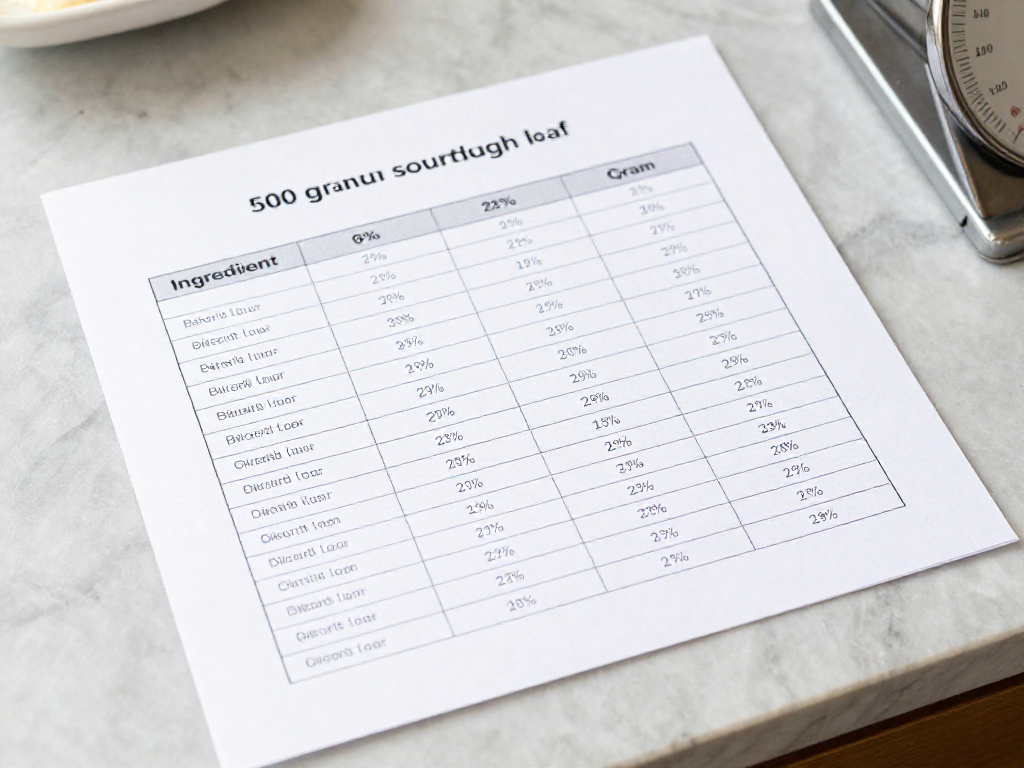
The short version: a baker's percentage tells you how much of each ingredient you have compared to the flour. Flour is always 100%, and everything else is measured against it. To get any percentage, you do one division: ingredient weight ÷ flour weight × 100.
Here's a typical beginner loaf:
| Ingredient | Weight | Baker's % |
|---|---|---|
| Bread flour | 500 g (about 4 cups) | 100% |
| Water | 350 g (about 1½ cups) | 70% |
| Sourdough starter | 100 g (about ½ cup) | 20% |
| Salt | 10 g (about 1¾ tsp) | 2% |
That 70% next to the water is the loaf's hydration — the amount of water relative to flour. You'll see "hydration" everywhere in sourdough; now you know it's just water as a baker's percentage.
Why weigh instead of using cups? A "cup" of flour can swing from 120 g to 150 g depending on how you scoop it. In cake baking you might get away with that. In sourdough, where the dough's behavior depends on getting the water-to-flour ratio right, a loose 30 g changes whether your loaf is workable or a sticky puddle. A cheap kitchen scale removes all the guesswork.
Why the percentages are worth the tiny bit of math:
- Scale any recipe up or down. Want a smaller loaf? Pick a new flour weight and reapply the same percentages.
- Compare recipes instantly. Two recipes look totally different in cups, but once you see "this one is 65% hydration and that one is 80%," you know exactly why one is stiffer and easier for beginners.
- Troubleshoot consistently. When a loaf comes out gummy or flat, percentages let you change one variable on purpose instead of guessing.
That's the whole idea — one division step, and the rest of this guide builds on it.
The Golden Rule: Flour Is Always 100%
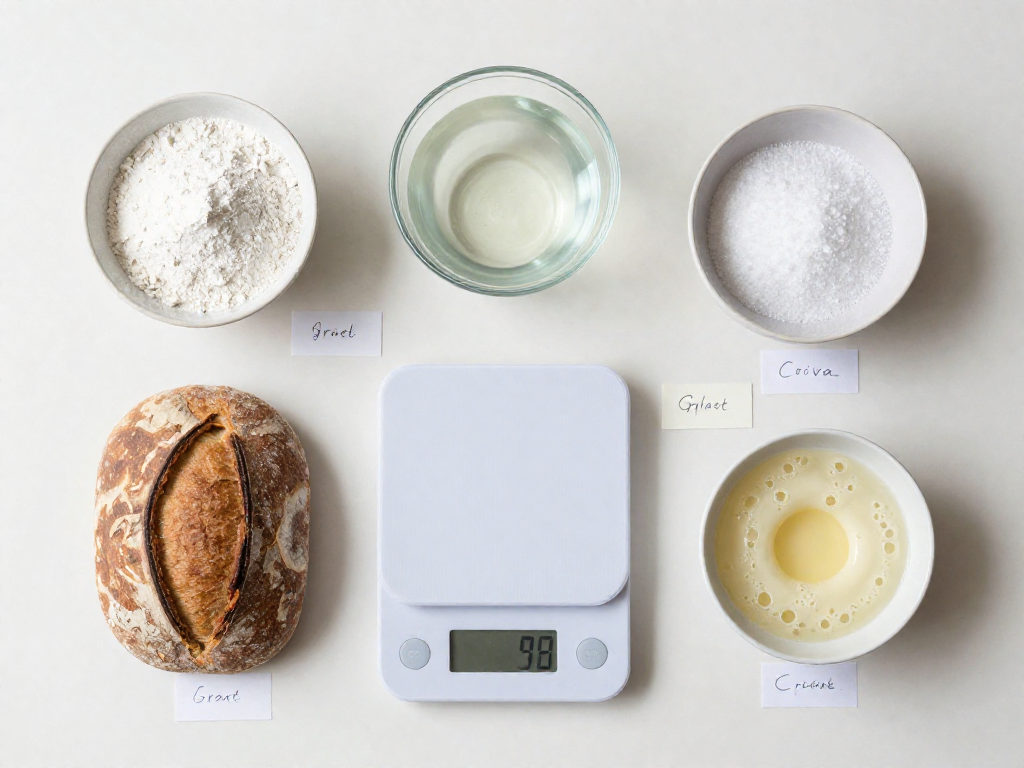
Here's the one rule that unlocks every baker's percentage you'll ever read: the total flour in your recipe always equals 100%. Everything else—water, salt, starter—is measured as a percentage of that flour weight. Learn this and the whole system clicks into place.
Start with the flour
Say your recipe calls for 500g flour. That's your 100%. Every other ingredient is calculated against it:
- Water at 70% = 350g (500 × 0.70)
- Salt at 2% = 10g (500 × 0.02)
- Starter at 20% = 100g (500 × 0.20)
Hydration is just baker-speak for the water percentage. A "70% hydration" dough simply means the water weighs 70% of the flour. That's it—no scary math.
Notice the percentages add up to more than 100% (here, 192%). That's normal and expected. Only the flour is pinned at 100%; the other ingredients stack on top.
What about two different flours?
This trips up beginners, so go slow. If a recipe uses white + whole wheat, the combined flour still equals 100%. You split that 100% between them:
- White flour at 80% = 400g
- Whole wheat at 20% = 100g
- Combined flour = 500g = 100%
Your water and salt are still calculated against that full 500g, exactly as before. The number of flours never changes the rule—they just share the 100%.
Why this makes recipes portable
Because everything is a ratio, a recipe works at any size. Want a smaller loaf? Use 300g flour instead of 500g and recalculate each ingredient at the same percentages. Want to double it? Use 1000g. The dough behaves the same way every time.
This is also why bakers swap recipes in percentages rather than cups: a "75% hydration, 2% salt" loaf means the same thing in your kitchen as in theirs, regardless of batch size. Once you think in percentages, every recipe becomes scalable and shareable.
Quick check: if flour is 500g and hydration is 75%, how much water? (Answer: 375g.)
Reading a Sourdough Recipe in Percentages
Here's a typical beginner formula. Read it top to bottom, and remember the rule from the last section: flour is always 100%, and every other ingredient is measured against that flour weight.
| Ingredient | Percentage | What it means |
|---|---|---|
| Flour | 100% | The base everything else is measured from |
| Water | 75% | 75g water for every 100g flour |
| Starter | 20% | 20g of active sourdough starter per 100g flour |
| Salt | 2% | 2g salt per 100g flour |
Starter here means your fermented mix of flour and water that makes the bread rise (your "yeast"). It should be bubbly and active before you use it.
Turning percentages into real weights
Pick a flour weight, then multiply. If you use 500g flour:
- Flour: 500g (4 cups) — this is your 100%
- Water: 500 × 0.75 = 375g (1½ cups)
- Starter: 500 × 0.20 = 100g (about ½ cup)
- Salt: 500 × 0.02 = 10g (1¾ tsp)
A kitchen scale in grams is far more accurate than cups, so weigh whenever you can. Cup measures are included as a backup.
Spot hydration at a glance
Hydration is simply how wet the dough is, written as the water percentage. Water at 75% means 75% hydration. The higher the number, the wetter and stickier the dough:
- 65–70% — firmer, easier to handle. Best for your first loaves.
- 72–78% — a touch sticky but very forgiving. Where most beginner recipes sit.
- 80%+ — slack and tricky. Save this until you're comfortable shaping.
Note: starter is roughly half water, so it nudges true hydration up slightly. You can ignore this when starting out.
Beginner-friendly ranges
- Water: 65–78%
- Starter: 15–25% (less starter = slower rise, more = faster)
- Salt: 2% almost always
Once these numbers click, you can read any sourdough formula and scale it to any batch size. Results will vary with your flour and kitchen temperature, so treat these ranges as a starting point, not a guarantee.
How to Calculate Weights From Percentages (Step by Step)
Here's the whole method in three steps. Once you do it once, you'll be able to scale any sourdough recipe up or down.
Step 1 — Pick your total flour weight. This is your starting point and it always equals 100%. A 500g flour batch is a comfortable size for one loaf, so we'll use that.
Step 2 — Turn each percentage into a decimal. Move the decimal point two places left: 75% becomes 0.75, 20% becomes 0.20, 2% becomes 0.02.
Step 3 — Multiply your flour weight by each decimal. That gives you the grams for each ingredient.
Worked example (500g flour)
Let's use a common beginner formula: 100% flour, 75% water, 20% starter, 2% salt.
- Flour: 500g × 1.00 = 500g (this is your 100%)
- Water: 500g × 0.75 = 375g (this 75% is the hydration — the weight of water as a share of flour)
- Starter: 500g × 0.20 = 100g (the starter is your fermented flour-and-water mix that makes the dough rise)
- Salt: 500g × 0.02 = 10g
That's it — no guesswork. The same math works for 1,000g of flour (just double every number) or 250g (halve them).
Copy-and-use table
| Ingredient | Percentage | Math (× 500g) | Grams | Cups (approx.) |
|---|---|---|---|---|
| Bread flour | 100% | 500 × 1.00 | 500g | 4 cups |
| Water | 75% | 500 × 0.75 | 375g | 1½ cups |
| Active starter | 20% | 500 × 0.20 | 100g | ½ cup |
| Salt | 2% | 500 × 0.02 | 10g | 1¾ tsp |
Tip: Cup measures are approximate because flour packs differently every time. A kitchen scale set to grams gives you the reliable, repeatable results that make sourdough far less frustrating.
To scale to any batch size, just swap your flour weight into Step 3 and recalculate — the percentages never change.
How to Scale a Recipe Up or Down
Scaling is just multiplication. Because baker's percentages (every ingredient written as a percent of the flour weight) never change with size, you only need to pick one number to scale from.
Method 1: Scale to the flour you have on hand
Say your recipe is built on 500g flour, but you only have 350g.
- Find the scale factor:
350 ÷ 500 = 0.7 - Multiply every other ingredient by 0.7.
| Ingredient | Original | × 0.7 |
|---|---|---|
| Flour (100%) | 500g (≈4 cups) | 350g (≈2¾ cups) |
| Water (70%) | 350g | 245g |
| Starter (20%) | 100g | 70g |
| Salt (2%) | 10g | 7g |
Method 2: Work backward from a total dough weight
Use this when your pan or banneton fits a known dough weight (a 9-inch Dutch oven loaf is roughly 900g of dough).
- Add up all the percentages:
100 + 70 + 20 + 2 = 192%, or 1.92 as a number. - Divide your target dough weight by that total:
900 ÷ 1.92 = 469g flour. - Multiply that flour weight by each percentage:
- Water:
469 × 0.70 = 328g - Starter:
469 × 0.20 = 94g - Salt:
469 × 0.02 = 9g
- Water:
One loaf vs. two
Doubling is the easiest scale of all: multiply everything by 2. To go from two loaves back to one, divide by 2. The dough will feel and look identical at every stage—same tackiness, same jiggle—because the ratios are untouched.
Why percentages don't change: a recipe at 70% water (often called 70% hydration) is 70% hydration whether you mix 100g of flour or 5kg. Size changes the weights; it never changes the relationships. That's the whole point of working in percentages.
Results vary by flour brand and kitchen humidity, so trust the dough's feel over the exact gram—add water a little at a time when scaling up a new flour.
Understanding Hydration and Starter Percentages
Two percentages cause most beginner confusion: hydration and starter percentage. Here's what each one means and how it shows up in your dough.
Hydration percentage: how wet the dough is
Hydration is the weight of water compared to the weight of flour. If a recipe uses 500g flour and 350g water, that's 70% hydration (350 ÷ 500 = 0.70).
What it feels like in your hands:
- 65–70% hydration: Slightly tacky but holds its shape. You can knead and shape it without it sticking everywhere. Start here as a beginner.
- 75–80% hydration: Wet, slack, and sticky. Great for an open, airy crumb, but it slides around and is hard to shape until you've built some skill.
If your loaf came out flat or you couldn't handle the dough, lowering hydration to around 68% is one of the fastest fixes. Less water = firmer, more forgiving dough.
Starter percentage: how fast it ferments
Starter (sometimes called levain) is the bubbly mix of flour and water that makes your bread rise. Starter percentage is its weight compared to the flour.
- More starter (20–25%): Faster fermentation. The dough rises sooner, which can be handy on a warm day or a busy schedule.
- Less starter (10–15%): Slower fermentation, more flexible timing, often better flavor.
If your loaf was dense or gummy, the dough may have been under-fermented—try a touch more starter or a longer rise.
Is the starter counted in the totals?
This trips everyone up. The flour and water inside your starter do count toward true hydration, but most beginner recipes ignore this for simplicity and list starter as its own percentage. For now, follow the recipe as written—the small difference won't ruin your loaf.
Note: Times vary by kitchen temperature and starter strength, so use the dough's look and feel as your guide, not the clock.
Common Mistakes Beginners Make With Baker's Percentages
Most dense, flat, or gummy loaves trace back to a handful of math slip-ups. Here's what to avoid.
1. Treating total dough as 100% instead of flour. In baker's percentages, flour is always the base (100%)—not the combined weight of the dough. If a recipe says 75% water and you accidentally divide by total dough weight, you'll add far too little water and end up with a stiff, dense loaf. Always set flour = 100% first, then calculate everything else from it.
2. Ignoring the flour and water hidden in your starter. Your sourdough starter (the living mix of flour and water that makes bread rise) is itself part flour, part water. A 100g starter at 100% hydration contains 50g flour and 50g water. If you forget this, your real hydration—the ratio of water to flour, written as a percentage—will be higher than you think, and the dough will feel wetter and slacker than expected. Count the starter's flour and water in your totals.
3. Measuring by volume instead of weight. A "cup" of flour can vary by 30g or more depending on how you scoop. Baker's percentages only work with a digital scale in grams. Volume measuring is the single most common cause of inconsistent results for beginners.
4. Panicking at high hydration and over-flouring. A 75–80% hydration dough is supposed to feel sticky. If you dump extra flour onto the bench to fight the stickiness, you quietly lower the hydration and bake a dense loaf. Use wet hands and a bench scraper instead of more flour.
See also
- How to Make and Maintain a Sourdough Starter
- Understanding Sourdough Hydration for Beginners
- Why Is My Sourdough Gummy? Troubleshooting Guide
- A Simple Beginner Sourdough Bread Recipe
- Essential Tools for Sourdough Baking: Why You Need a Scale
Related articles
Stop Aiming for 'Perfect': Redefining Sourdough Success as a Beginner
Should beginners lower their expectations for a perfect loaf?
Jul 28, 2026 · 4 min read
The Shaping Secret: How Your Technique Affects Oven Spring and Crumb
Discover why shaping is the secret to amazing oven spring and open crumb in sourdough. Learn how surface tension, dough shape, and proper technique can transform your loaves.
Jul 28, 2026 · 10 min read
Sourdough Lingo You Don’t Need: Simple Words Instead of ‘Autolyse’ and ‘Crumb’
Why do sourdough bakers use so much jargon, and what simple substitutions can I use?
Jul 20, 2026 · 4 min read